
Authors: Kyle Znamenak, Anthony Adkisson, Catherine Hansman
Adult learning occurs across workplaces, communities, and other settings, yet adult education still faces challenges in achieving consistent recognition as a distinct discipline. That challenge is heightened by the rebranding and closure of adult education programs at universities. Podcasts may serve as a medium for reaching broader audiences, highlighting adult education scholarship, and amplifying diverse voices in the field, while social media can help extend that reach beyond traditional academic spaces. We explore how OD Learning Lab, a podcast focused on adult learning, leadership, and organization development, may support disciplinary identity, public scholarship, and broader engagement.
The field of adult education continues to struggle, as it has for the past 50 years, to be recognized as a distinct discipline (Rose & Hansman, 2019). That challenge is now compounded by the rebranding and dismantling of adult education programs at universities (Hansman et al., 2023). As two adult educators with experience as academics and practitioners, we explore the benefits of podcasts and social media as platforms for preserving the field’s historical voices, expanding access to broader audiences, and sharing the value of adult learning theories and research beyond traditional academic circles. Although we now work as scholar-practitioners, we entered adult learning with limited knowledge of the field’s theories, theorists, and foundations. Our desire to reach broader audiences stems from our understanding that many practitioners lack these foundations.
Podcasts support formal and informal learning, self-directed learning, reflection, and meaning making (Harter et al., 2024; Meden et al., 2024). About 54% of adults in the United States have listened to a podcast within the past 12 months (Pew Research Center, 2025). Despite this reach, podcasts remain underutilized as a vehicle for increasing access to and understanding of adult education theory and research within and beyond traditional academic contexts (Engzell, 2025). In leadership courses, podcasts offer flexible examples that help adult learners understand course concepts (Bletscher & Council, 2022). Similarly, scholarly podcasting enables researchers to share their research with the public and reach broader audiences than traditional academic channels, such as conferences and journal publications (Persohn & Branson, 2025).
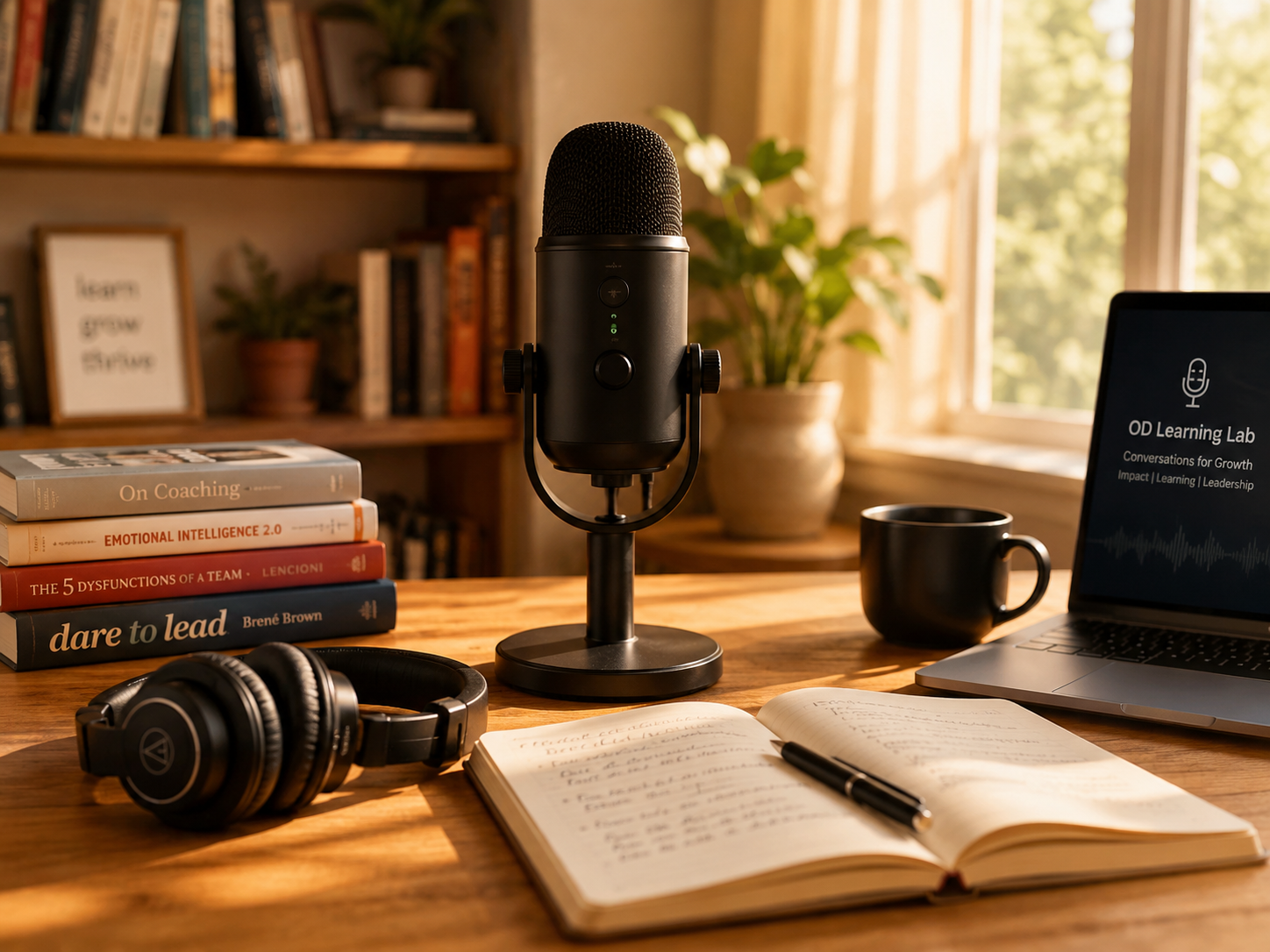
This raised the question of how practitioners outside graduate programs learn the theoretical frameworks that shape our field. To reach diverse audiences, we created OD Learning Lab (n.d.), a podcast on organizational development, leadership, and adult learning.
In October 2025, Catherine Hansman joined us to discuss her research on mentorship. While planning for the podcast, Catherine introduced us to the work of Dr. Gretchen Bersch. Gretchen taught at the University of Alaska Anchorage for 35 years and led its master’s program in Adult Education. She is also the creator of Conversations on Lifelong Learning (Bersch, n.d.), a significant archival collection of interviews with foundational adult education scholars, including Houle, Mezirow, Knowles, Cross, Apps, and many others. Produced from the early 1980s to the 2000s, the interviews are a major, underutilized adult education archive.
Approach
We explore how podcasts and platforms such as YouTube may increase access to adult education theory and research. Without intentional preservation, historical narratives and scholarly voices risk being lost; podcasting offers one method for capturing and sustaining these voices, bridging the past and the future by preserving the contributions of past scholars while creating space for future scholarly voices (Morris & Hoyt, 2021).
Our podcast initiative bridges theory and practice in adult learning, leadership, and organizational development. It pairs two adult educators, both with experience as academics and practitioners. Together, we create a platform integrating foundational theory, contemporary research, and applied practice. A case study of a similar podcast, Adventures in Advising, with over 100 episodes, suggests that their podcast expanded access to timely and equitable professional development, fostered community and reduced isolation, supported the transformation of practice and professional identity, and broadened global perspectives (McGill & Markin, 2026).
A core component of the project involves collaborating with Dr. Gretchen Bersch (Professor Emerita, University of Alaska Anchorage), Dr. Catherine Hansman, and Dr. Laura Bierma to preserve and extend the reach of Gretchen Bersch’s archival collection of recordings, originally housed on DVDs, through the podcast and International Adult and Continuing Education Hall of Fame (n.d.). We intend to work with Gretchen to select excerpts for the podcast episodes and pair them with contemporary analysis. Our aim is to connect historical insights and foundational knowledge to current issues in adult learning, organizational development, and leadership practice, while introducing these voices to a diverse audience. The podcast will be shared across multiple social media platforms, including YouTube and Instagram. As recently as 2024, Vasinda et al. (2024) explored, through a phenomenological study, the impact of social media on scholarly identities and participation in public scholarship, aiming to understand how the field may expand its reach through these platforms.
The current project aims to preserve historically significant scholarship, introduce foundational theorists to a new generation of researchers and practitioners, and model the critical integration of classical theory with present-day challenges through podcasting and social media. Our podcast format includes topic-based mini-series, beginning with clips from Conversations on Lifelong Learning. Each session would consist of the following components:
- Archival Discussion: An introduction to a historical scholar that features selected 15–20-minute excerpts from the original recording, interwoven with host commentary that highlights key ideas, historical context, and relevance for contemporary adult learning scholarship.
- Contemporary Academic Discussion: A conversation with a current scholar or practitioner in the field, inviting them to share their perspectives on contemporary issues and engaging in a format inspired by Gretchen’s original interviews.
- Translating the Field: A concluding host-led discussion where we synthesize insights across the archival and contemporary conversations, identify implications for practice, and reflect on what these ideas suggest for the future of adult learning and education.
Conclusion
Podcasts can serve as an important medium for expanding access to knowledge and making scholarship more accessible to practitioners, while social media can help extend that reach. The OD Learning Lab is one effort to bridge scholars and practitioners, increase awareness of the field of adult education, and make its ideas more visible to both academic and non-academic audiences through archival perspectives, contemporary discussions, and connections between theory and practice. As this work continues, further research is needed to better understand the impact of the OD Learning Lab and the broader potential of podcasting as a vehicle for public scholarship, disciplinary visibility, and adult learning discourse.
AI USE STATEMENT
ChatGPT and Grammarly were used only to support editing, clarity, and proofreading of the text. AI tools were not used to generate original content, analysis, or conclusions.
REFERENCES
Bersch, G. T. (n.d.). Conversations on lifelong learning. https://conversationsonlifelonglearning.com/
Bletscher, C., & Council, A. (2022). The power of the microphone: Podcasting as an effective instructional tool for leadership education. Journal of Leadership Education, 21(4), 1–23. https://doi.org/10.12806/V21/I4/A1
Engzell, J., Norrman, C., Norberg, A., & Lundvall, C. (2025). Soundwaves of knowledge: Using podcasts to facilitate learning in higher education. Educational Media International, 62(3), 361–379. https://doi.org/10.1080/09523987.2025.2533120
Hansman, C. A., Green, W. M., & Wlodarsky, R. (2023). Investigating adult education graduate program trends in a post-COVID-19 environment. Adult Education Research Conference. https://eric.ed.gov/?q=labor+AND+human&ff1=locOhio&pg=3&id=ED649300
Harter, L. M., Bianco, J. A., & Cameron, C. (2024). Podcasting as storycrafting and translational health communication scholarship. Health Communication, 39(14), 3532–3535. https://doi.org/10.1080/10410236.2024.2326266
International Adult and Continuing Education Hall of Fame. (n.d.). The University of Oklahoma. https://halloffame.outreach.ou.edu/
McGill, C. M., & Markin, M. (2026). Public scholarship in practice: A case study in podcasting for professional learning in higher education. New Horizons in Adult Education and Human Resource Development, Advance online publication. https://doi.org/10.1177/19394225261432698
Meden, E., Radovan, M., & Štefanc, D. (2024). Podcasts and informal learning: Exploring knowledge acquisition and retention. Education Sciences, 14(10), 1129. https://doi.org/10.3390/educsci14101129
Morris, J. W., & Hoyt, E. (Eds.). (2021). Saving new sounds: Podcast preservation and historiography. University of Michigan Press.
OD Learning Lab. (n.d.). OD Learning Lab. Retrieved April 13, 2026, from https://odlearninglab.com/
Pew Research Center. (2025, September 25). Podcasts and news fact sheet [Fact sheet]. Pew Research Center. https://www.pewresearch.org/journalism/fact-sheet/podcasts-and-news-fact-sheet/
Persohn, L., & Branson, S. (2025). Scholarly podcasting for research dissemination: A scoping review. SAGE Open, 15(1), 1–16. https://doi.org/10.1177/21582440241311694
Rose, A. D., & Hansman, C. A. (2019). Serving the world or building a profession: The confounding dilemmas of mid-twentieth century academic adult education. Adult Education Research Conference. https://newprairiepress.org/aerc/2019/papers/13/
Vasinda, S., Donovan, S. J., Huang, J., Valencia-Pate, A., & Hicks, J. (2024). Interrogating hierarchies: academic use of social media for public scholarship. Literacy